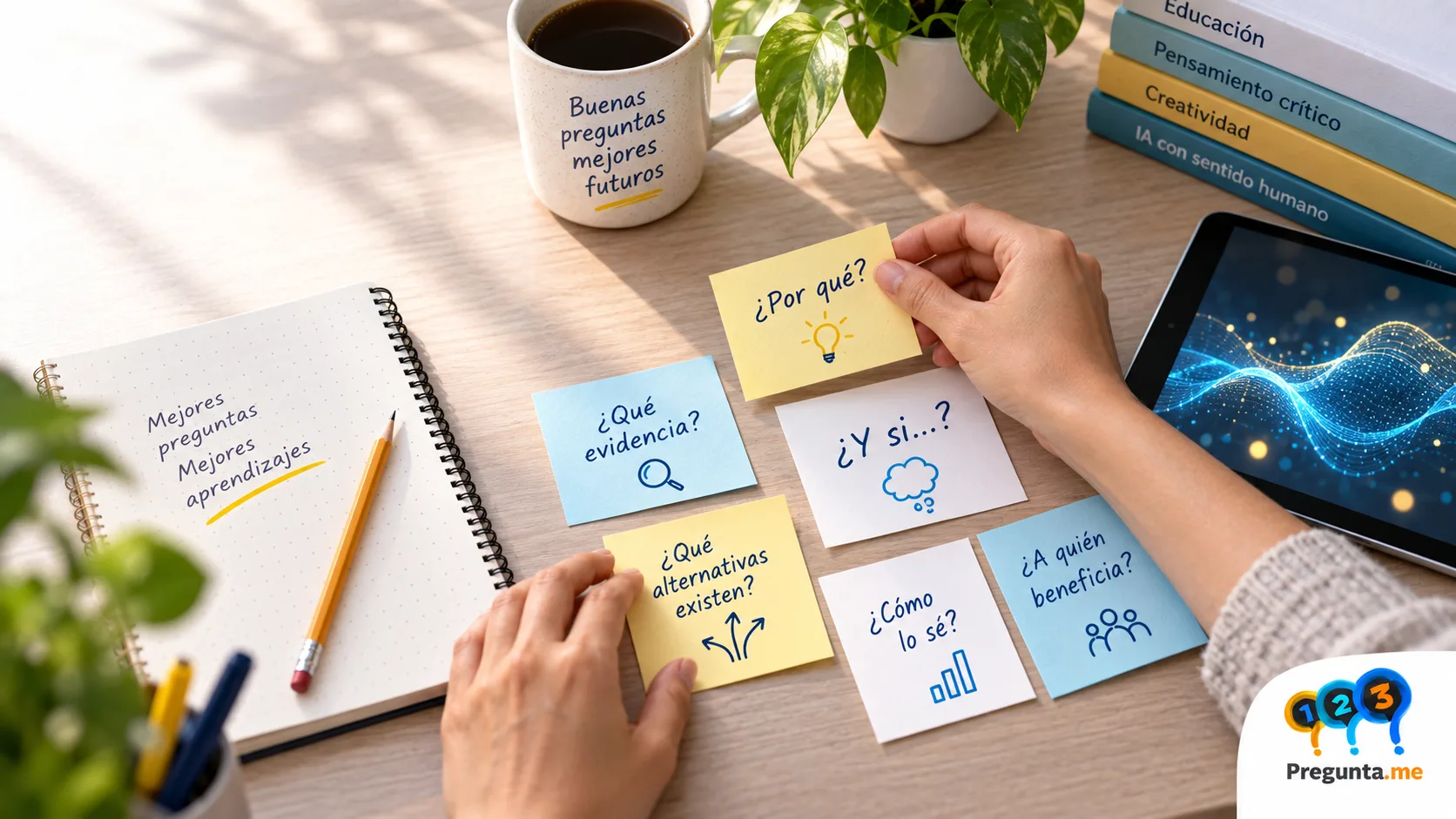
In the age of artificial intelligence, answers are increasingly accessible. A student can request an explanation, a summary, or an example within seconds. A teacher can generate activities, questions, or materials much more quickly than before.
But in education, speed is not everything.
If AI allows us to access answers easily, then one of the most important skills will be learning to ask better questions.
Asking well is not just a technique; it’s a way of thinking. A good question can open a conversation, reveal confusion, connect ideas, and challenge students to view content from a different perspective.
That’s why, in the age of AI, critical thinking doesn’t necessarily begin with the answer. Often, it starts with the question.
The Question as a Learning Tool
In the classroom, questions serve many purposes. They activate prior knowledge, check understanding, encourage discussion, assess learning, and stimulate curiosity.
But not all questions foster the same type of thinking.
A question like “What is photosynthesis?” can help review a concept. In contrast, a question such as “What would happen to a plant if it didn’t receive sunlight for a week? Explain your answer using the concept of photosynthesis” invites students to apply, connect, and justify their reasoning.
The difference lies in the depth of reasoning expected.
The most powerful questions often ask students to explain, compare, argue, analyze evidence, propose solutions, or imagine consequences.
These questions don’t merely aim to verify whether someone remembers something; they seek to have the student use what they know to think more critically.
What Changes with Artificial Intelligence?
Generative AI can be a great ally for teachers and students. It can help create examples, rephrase explanations, generate questions, adapt materials, and suggest activities.
However, it also presents a challenge: if students simply copy AI-generated answers, learning becomes impoverished.
Therefore, the focus should not be solely on banning or permitting tools. The focus should be on teaching students to use them thoughtfully.
One concrete way to do this is by working with questions such as:
- Which part of this answer seems well-founded?
- What information is missing?
- What evidence would we need to verify it?
- What other explanation might exist?
- How would you improve this answer?
- What biases or errors might this information contain?
- How would you explain it in your own words?
These questions turn AI into a starting point, not the end of the learning process.
Critical Thinking Is Not About Distrusting Everything
Sometimes, critical thinking is understood as a permanent attitude of suspicion. But in education, thinking critically does not mean rejecting everything. It means analyzing carefully.
It involves questioning the quality of information, the strength of arguments, the sources used, the assumptions involved, and the implications of an idea.
In a world overflowing with information, this skill is increasingly important. Simply finding data is not enough; you must know how to interpret it.
AI can assist, but it can also make mistakes. It may provide convincing answers that are not always correct. That’s why students need to learn to cross-check, review, and justify their responses.
This is where the teacher’s role becomes essential.
The Teacher as Designer of Good Questions
Technology can suggest many questions in a short time, but pedagogical judgment remains human.
Teachers understand the course level, learning objectives, common difficulties, their students’ context, and the purpose of each activity.
A good AI tool can help generate questions aligned with the course, subject, unit, theme, learning objective, and difficulty level. However, it is the teacher who decides which ones to use, how to adapt them, and what kind of discussion they want to spark.
For example, for the same unit, questions can be designed at different levels:
- Questions to recall key concepts.
- Questions to understand processes.
- Questions to apply content to specific cases.
- Questions to analyze causes and consequences.
- Questions to evaluate perspectives.
- Questions to create proposals or solutions.
This approach allows moving from assessments focused on simple answers toward deeper learning experiences.
How to Put It Into Practice
A simple strategy is to review the questions already used in class and consider what type of thinking they stimulate.
If most begin with “name,” “define,” “identify,” or “list,” we are likely assessing primarily memory and basic comprehension.
To promote critical thinking, we can incorporate verbs such as:
- explain
- compare
- justify
- analyze
- argue
- evaluate
- propose
- predict
- relate
- design
We can also ask for evidence: “justify your answer,” “use an example,” “explain your reasoning,” “compare two alternatives.”
The goal is not to make every question difficult. It’s about building a progression: starting with the essentials and moving toward deeper application of knowledge.
An Opportunity to Personalize Learning
In large classrooms, creating differentiated questions can take a lot of time. This is where AI can truly add value.
It can help generate versions of a question tailored to different difficulty levels, create context-specific examples, suggest follow-up questions, or transform a closed-ended question into an open-ended one.
This gives teachers more options to support students with varying paces and needs.
A platform like 123Preguntame aims precisely at this: facilitating the creation of questions and educational resources so that teachers can dedicate more time to what matters most—teaching, supporting students, and making pedagogical decisions.
Conclusion
Artificial intelligence can deliver quick answers. But education needs something deeper: students capable of thinking, questioning, justifying, and creating.
That’s why, in the age of AI, asking better questions is a key skill.
A good question can turn an automated response into a meaningful conversation. It can transform a simple activity into an opportunity for reflection. It can help students not only learn content but also learn to use that content thoughtfully.
Because learning is not just about finding answers.
It’s also about learning to ask better questions.
References
UNESCO: Guidance for Generative AI in Education and Research
https://www.unesco.org/en/articles/guidance-generative-ai-education-and-researchUNESCO IBE: Critical Thinking and Generative Artificial Intelligence
https://www.ibe.unesco.org/en/articles/critical-thinking-and-generative-artificial-intelligenceMineduc: Guide for teachers: How to use ChatGPT to enhance active learning
https://bibliotecadigital.mineduc.cl/handle/20.500.12365/19453OECD: What Should Teachers Teach and Students Learn in a Future of Powerful AI?
https://www.oecd.org/en/publications/what-should-teachers-teach-and-students-learn-in-a-future-of-powerful-ai_ca56c7d6-en.html